Some people read to escape reality. Others read to plan their next vacation. If you’ve ever closed a book and thought, “Okay, but how do I get there IRL?” — this list is for you. Literature is full of fantastical places, but it turns out quite a few of them are hiding in plain sight, scattered across the globe and just waiting for you to show up with a camera and a smug grin.
Here’s your Weird and Wonderful passport to the real-life locations behind some of the world’s most famous fictional worlds.
The Moors of Wuthering Heights

? Yorkshire, England
? Wuthering Heights by Emily Brontë
If brooding men, tragic romances, and wind-blasted heaths are your aesthetic, Yorkshire’s Haworth Moor is calling. These desolate, mist-snarled landscapes inspired Emily Brontë’s Wuthering Heights, and you can still stomp across the same wild paths that Heathcliff and Cathy once (fictionally) haunted. Expect sheep. Expect wind. Expect to feel like life itself is a Gothic novel and you’re overdue for some heartbreak.
Baker Street, London

? 221B Baker Street, London, England
? Sherlock Holmes by Arthur Conan Doyle
Yes, Sherlock Holmes is fictional. Yes, 221B Baker Street is now a museum. No, that hasn’t stopped legions of tourists from writing earnest letters to the world’s most famous non-existent detective. Step inside the Victorian townhouse to find pipe paraphernalia, Persian slippers, and other Holmesian artifacts lovingly curated for your sleuthing pleasure. Bonus: The gift shop is full of things you definitely don’t need but will absolutely buy.
Prince Edward Island (Anne of Green Gables)

? Cavendish, Prince Edward Island, Canada
? Anne of Green Gables by L.M. Montgomery
If you’ve ever longed to walk among raspberry cordial, haunted woods, and scenic farmhouses with dangerously imaginative redheads, Cavendish delivers. Green Gables Heritage Place recreates the world of L.M. Montgomery’s beloved Anne with shocking attention to detail. The landscapes — red cliffs, gentle fields, whispering trees — feel lifted straight from the pages, because they practically were. Prepare for more quaintness than you thought humanly possible.
The Overlook Hotel (aka The Stanley Hotel)

? Estes Park, Colorado, USA
? The Shining by Stephen King
“All work and no play…” — you know how it ends. Stephen King’s stay at the Stanley Hotel in Estes Park inspired The Shining, and while the hotel isn’t actually haunted (probably), it leans into the reputation with ghost tours, creepy corridors, and typewriter displays. Don’t expect a hedge maze, but do expect chills, thrills, and possibly your own Room 217 moment.
Verona’s Juliet Balcony

? Verona, Italy
? Romeo and Juliet by William Shakespeare
Plot twist: Juliet Capulet never lived here, and Shakespeare never visited. Yet in Verona, you can queue up to stand on Juliet’s Balcony — a 14th-century addition grafted onto a medieval house long after the fictional fact. People still scribble love notes on the walls, rub the statue of Juliet for luck, and propose in the courtyard. Is it historically accurate? Absolutely not. Is it weirdly romantic? Obviously.
Platform 9¾ at King’s Cross Station

? London, England
? Harry Potter by J.K. Rowling
Does it exist? Technically no. Does it exist anyway? Absolutely. King’s Cross embraced its fictional fame with a dedicated Platform 9¾ photo op, complete with luggage trolley disappearing into a wall and a nearby Harry Potter shop selling every wizarding necessity short of actual spells. Brace yourself for long lines and excitable Gryffindors-in-training.
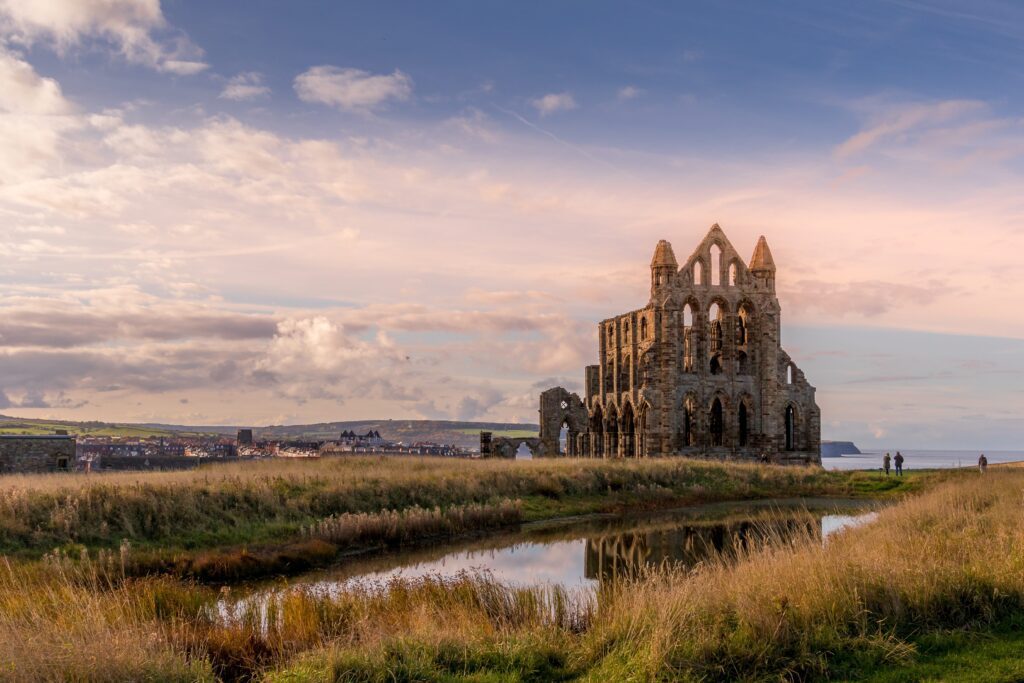
Whitby Abbey (Dracula)

? Whitby, England
? Dracula by Bram Stoker
Perched dramatically above the North Sea, the crumbling ruins of Whitby Abbey served as a key location in Dracula. Bram Stoker visited Whitby and was reportedly inspired by the gothic decay, wild cliffs, and the town’s tales of shipwrecks. Today, you can climb the famous 199 steps to the abbey and imagine Count Dracula arriving in the form of a storm-borne dog. Or just enjoy the seagulls. Your choice.
Shakespeare and Company, Paris

? Paris, France
? A Moveable Feast by Ernest Hemingway (and many others)
Forget fictional mansions — how about a real-life bookstore so literary it practically smells like ink and existential crisis? Shakespeare and Company in Paris isn’t just any bookshop; it’s a living monument to the Lost Generation, the Beat poets, and backpack-toting dreamers. Featured in Hemingway’s A Moveable Feast, this ramshackle haven on the Seine has hosted everyone from James Joyce to Patti Smith. You can browse rare editions, pet the resident cat, and even sleep among the stacks if you’re a struggling writer (seriously — it’s called “Tumbleweed tradition”). It’s as close to stepping inside a beloved novel as Paris gets.